With new international student enrollment down 17% this year, many are asking about the corresponding impact on the student housing industry. At Blue Vista, we believe the impact will be muted due to the unique characteristics of purpose-built student housing and the enduring appeal of a U.S. college education.
Key Takeaways
- Total international enrollment is only down 1% since 2024, despite new international enrollment being down by 70k students (17%).
- Despite fewer new international students, student housing market demand remains strong with overall student housing occupancy at 95%+.
- Tier 1 schools can maintain and drive enrollment from domestic students, offsetting softness from foreign applicants.
- The most challenged schools are smaller Tier 2 universities where a modest numerical decline in international enrollment can have an outsized impact.
- New deliveries at the highest price points may face some challenges due to a typically higher reliance on international students but, overall, most markets will remain healthy.
International Students in the U.S.
The U.S. is the top destination for international students globally, with almost 1.2 million students studying in the U.S. from abroad, making up 6% of overall university enrollment.1 With the exception of COVID, the number of international students has trended steadily upward for decades. While a small percentage of the overall student population, international students can be ready consumers and tend to favor top-of-the-market assets. International students are also major economic engines, with an estimated $55 billion positive economic impact to the nation’s economy.¹
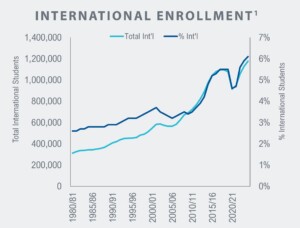
There are over 6,000 colleges and universities in the U.S. and international students study in all 50 states. However, six states (CA, TX, NY, MA, PA, IL) each enroll more than 50,000 international students and account for half of all international enrollment in the U.S.¹, implying that certain markets and schools have outsized international student populations. Given many of these students’ preference for purpose-built student housing, they have been a key cohort to monitor in the U.S. student housing landscape.
Today, U.S. policy shifts, visa processing delays, and concerns over future restrictions on foreign students are challenging international demand. Enrollment by new international students dropped 23% over the past two academic years, including a 17% decline in new enrollment in the Fall 2025 semester.¹ This represents a decline of roughly 70,000 students. Most pronounced are the declines in the international graduate student population, which makes up 22% of all full-time graduate students in the U.S. Lastly, federal travel and visa data shows that student visa arrivals in August 2025 dropped by 19% compared to the same month in the previous year, marking one of the largest declines in recent history.²
Impact on Student Housing Demand
Although recent federal policy initiatives have created many headwinds for international students, total international enrollment is only down 1%. Whether this is the beginning of an enduring decline or a policy-led blip is unknown; however, it appears that the overall impact on the health of student housing is less significant.
The largest decline in international students is among graduate students, and while a significant percentage of the international student population, graduate students tend not to be big consumers of purpose-built student housing, instead choosing to live in traditional multifamily or other forms of off-campus housing. Over 90% of purpose-built student housing targets undergraduate students, making the property type less exposed to the cohort most exposed to policy and funding headwinds.
Despite the headlines, the U.S. student housing market remains strong with 95%+ overall occupancy in Fall 2025, a 1.5% year-over-year increase.³ Going further, industry data provider RealPage shows its top 175 schools at 96.7% occupancy.4 Blue Vista conducted an analysis of its portfolio and examined a) universities nationally with the highest numbers of total international students and b) how Blue Vista-owned properties with a larger percentage of international students are performing. Even at the U.S. universities with the largest number of international students, student housing occupancy has remained stable, and in many markets, occupancy has even increased. Similarly, Blue Vista’s top 10 properties, in terms of percentage of international students, showed similar trends, with these properties collectively leasing to 96.8%, 1.8% greater than the prior year.
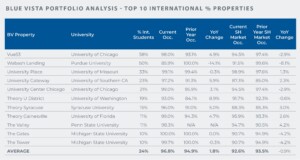
As evidenced in the chart above, overall ongoing student housing demand is supported by strong enrollment trends. Fall 2025 enrollment data show total postsecondary enrollment increasing 2% over the previous academic year. Graduate enrollment remained steady this fall, increasing by 0.1%, despite the declining foreign enrollment.5 Only one of Blue Vista’s “international” properties showed a decline in enrollment. This likely indicates that although international student numbers are falling, domestic students are absorbing demand, leaving the overall student housing market largely unaffected.
When the total enrollment numbers are released later this year, we expect to see an increase in domestic enrollment as top universities likely increased domestic enrollment to offset revenue losses from a decline in international students. Most markets have modest international student populations as international students tend to concentrate. The three largest markets for undergraduate international students (NYU, Northeastern, and Columbia) comprise 6% of all international students6 but offer a de minimis amount of purpose- built student housing product. Blue Vista believes that smaller Tier 2 universities are the most challenged, where a modest numerical decline in international student enrollment can have an outsized impact.
Looking Ahead
International demand may continue to remain below historical levels, whether due to policy shifts or changing demographics. However, foreign students’ $55 billion positive economic impact will likely pressure for a shift in policy favoring more enrollment, not less. This is not a red state/blue state issue; of the eight states showing the largest growth in economic impact from foreign students, six would be considered red, while only two are blue.6
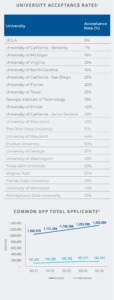
Demand for Tier 1 schools will remain strong, as evidenced by recent application trends. These schools will be able to drive yields to manage enrollment. Public schools will increase their enrollment of out-of-state students who pay full tuition, offsetting the impact of fewer international students. Acceptance rates at many of the largest state schools are low (see chart to the right), providing plenty of room to increase yields if needed.
Overall demand for U.S. colleges remains strong. The Common App notes 1.5 million unique first year applicants for ‘24/’25 which reflects a 7.23% CAGR over the past 5 years, and total applications on the Common App exceeded 10 million for the first time in ‘24/’25.8
New deliveries targeting the top of the market rents may be challenged over the next few years as these are favored by international students. As an example, within Blue Vista’s portfolio, our higher priced assets (over $1,400/bed) have the highest exposure to international students who compose more than 15% of residents.
How Can the Risk Be Mitigated?
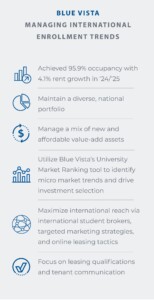 Active management drives student housing operating performance. As an example, Blue Vista and its affiliate, PeakMade Real Estate, delivered 95.9% same-store occupancy with 4.1% rent growth for the ‘25-’26 AY.
- Maintain a diverse, national portfolio that can minimize international student exposure in any one asset.
- Focus on investing at larger Tier 1 schools. Well-capitalized markets will likely be enrollment “winners”, capturing a larger share of remaining international demand while continuing to benefit from strong domestic demand.
- Manage a mix of new and affordable value-add assets with less exposure to high-end assets favored by international students.
- Support international leasing velocity by leveraging strategic relationships with international student brokers, targeted marketing strategies, and online leasing tactics.
- Know the micro-market. Certain assets may be more exposed than others, even at schools with a low % of international students.
- Prioritize investing in universities with more selective acceptance rates, which we believe will be more resilient to international enrollment changes as these schools can better control their total enrollment.
Notes
-
Institute of International Education, “2025 Open Doors Report on International Educational Exchange”
-
International Trade Administration, “August 2025 COR Summary & Analysis”
-
Multi-Housing News, “National Student Housing Report – October 2025”
-
O’brien, RealPage, Student Housing Leasing, September 2025
-
National Student Clearinghouse Research Center, November 11, 2025
-
OpenDoors 2025
-
U.S. News, Admissionsight.com Top 25 Public Universities, 2025
-
Common App, End of Season Report 2024-2025